

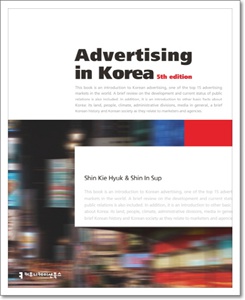
한국 광고를 영문으로 설명한 이유는? 전 세계 광고 규모 15위 한국 광고에 대한 정보가 없다. 이 책은 한국 광고 산업을 영어로 설명한 유일한 책이다. 어떤 정보를 담았나? 한국 기후, 지리, 인구, 종교 문화부터 한국 광고의 역사, 발전, 현황, 매체, 관련 법규, 대학 교육, 광고 단체, 광고제까지 알차게 담았다. 개정 5판은 무엇을 개정했나? 전부 업데이트했다. 광고인 신기혁과 신인섭이 해외 마케터와 해외에서 활동하는 국내 기관과 기업에 요긴한 정보를 엄선했다.
Kie H. Shin, Ph.D.
Kie H. Shin. His advertising career started in 1985 after his postgraduate study(Master of Journalism) at North Texas State University(now University of North Texas) in Denton, Texas. His first assignment was ad sales and news gathering for the Korean Community Journal Dallas edition, headquartered in Houston. He came back to Korea in 1987 and started as an account executives in the International Division at Nara Advertising, which was affiliated with J. Walter Thompson at that time. After two years there, he moved to Sales Promotion Division in the same company to promote the Korean billboard business in China. While he was at Nara, his main accounts included IBM and R.J. Reynolds. In 1991, he moved to MBC Adcom as an account supervisor and worked with FCB for Northwest and other FCB accounts. After resigning from MBC Adcom as an account director, he started his own business in 1996 doing event promotion and marketing consulting.
In 1998, while running his business, Shin started to teach advertising classes at Chungwoon University, and he turned from business to teaching. In 2002, he became a full time professor at Kyongju University. In November 2003, he earned his doctorate degree at Chung-Ang University. His thesis was The American and Japanese influencing on the formation and development of modern advertising in Korea.
Shin has authored Easy Access to Advertising Planning, and co-authored Introduction to Advertising, International Advertising and PR, Advertising Media Terminology Handbook, Introduction to TV-CM production, History of American Advertising. He also has translated The Art of Cause Marketing by Richard Earle into Korean.
In Sup Shin.
Mr. Shin's advertising career extends close to half a century. He started his career as the advertising manager for two newspapers published in Seoul. For the next six years. Shin was in charge of advertising for the present GS Caltex, a joint venture with U.S. Caltex. He was the director in charge of advertising for Hee Sung, which later became LG AD (now HD AD) and one of the top five agencies in Korea. Shin also served as an advisor for Korad, the Ogilvy & Mather associate. He laid the ground work for the launch of the Korea Audit Bureau of Circulations as its managing director. He was the secretary general for the 14th Asian Advertising Congress in 1984 and the 35th IAA World Advertising Congress in 1996, two international advertising events Korea hosted for the first time. He is the founding member of the IAA Korea Chapter in 1968. He is the first president of the Seoul Copywriters Club launched in 1976.
Shin has written over a dozen books on advertising and public relations, including Advertising Copywriting, International Advertising and Public Relations, The History and Development of Advertising in Korea, Advertising in Japan and Advertising in China. As he grew older, he co-authored American Advertising and History of Public Relations in Korea. Advertising in Korea, the only English-language book on Korean advertising and public relations in general initially published in 1974 was revised four times. These books were the first of their kind in Korea. He lectured widely as a visiting professor at four leading universities in Seoul. Currently, he is a visiting professor at Chung-Ang University.
Shin is member of the Korea Advertising Society, The American Academy of Advertising, the Japan Advertising Academy and the Public Relations Society of America as well.
추천사
Nearly a decade ago, this was the only comprehensive English language treatment of the origins, growth and current status of advertising in Korea. It remains so and takes on added interest in light of the digital information revolution that has transformed Korea's media landscape. The insights of the senior author, Shin In Sup form a first-person history and cultural context that should be required reading for all who do business in this large, lively and unique advertising market.
James F. Larson, Ph.D.
Visiting Professor, Korea Advanced Institute of Science & Technology (KAIST)
This up-to-date publication on Korea's marketing communications industry tells the full story cadidly, with facts and figures, including historical background.
Soon Dong Lee
Chairman, Korea Federation of Advertising Associations
In addition to advertising and public relations, this book gives you an insight into Korean culture and media. The two practitioner-turned-academics tell a concise historical background of the Korean media, advertising, and agencies as well to help readers better understand current status of the advertising and public relations industry. Advertising in Korea is the only such publication in English.
Dai Ki Lim
President, Cheil Worldwide.
Despite its ad expenditure ranking in the world, recognition of South Korea's advertising in general lags far behind in global stage. Why? Language barrier, This book is the only genuine efforts to fill the gap. The two practitioner-turned-academics provide an excellent guide to the thriving Korean marketing, advertising and public relations. Advertising in Korea is a "must read" for anyone who has an interest in marketing communications business in Korea.
Jay Paik
President, Diamond Ogilvy & Mather
책 속으로
This book is an introduction to Korean advertising, one of the top 15 advertising markets in the world. A brief review on the development and current status of public relations is also included. In addition, it is an introduction to other basic facts about Korea: its land, people, climate, administrative divisions, media in general, a brief Korean history and Korean society as they relate to marketers and agencies.
While Korea has been one of the largest advertising markets in the world since the mid-1990s, there are hardly any publications in English which cover the development and current status of Korean advertising and public relations.
_<FOREWORD> 중에서
In 1975, Professor Yoo Jae Chun, a noted mass-communications scholar, discovered an advertisement placed by Edward Meyer & Company (Sechang Yanghaeng in Korean), a German trading firm active in Korea in the late 19th century. It was the first modern Korean newspaper advertisement. The ad, appearing on February 22, 1886, in the Hanseong Jubo, a weekly published by the government, was entirely in Chinese characters. (Koreans used Chinese characters mixed with Hangeul, the Korean alphabet, more in those days, although use of Hangeul alone is predominant now.) It was a narrative statement of what the German company imported to and exported from Korea. The size of the weekly was 24.5 cm top to bottom and 16.5 cm wide.
_<CHAPTER 2. THE DEVELOPMENT OF KOREAN ADVERTISING, 1886 – 2012> 중에서
By the mid-1920s, advertisements for Japanese products exceeded those for Korean products, reaching around 50 percent for the two Korean dailies and increasing to 65 percent by 1935. Dependence on the revenue from Japanese advertisements became so important that the Korean newspapers established branches in Tokyo. Advertising revenue varied from 31 percent to 45 percent of the total income of the Dong-A Ilbo between 1920 and 1940. In terms of the types of advertisements, and taking 1938 for the Dong-A Ilbo as an example, pharmaceutical products represented around 50 percent followed by 13 percent for cosmetics, 6 percent for foods, another 6 percent for books and garments, 6 percent for movies, 5 percent for machinery, and the rest for miscellaneous products.
_<CHAPTER 2. THE DEVELOPMENT OF KOREAN ADVERTISING, 1886 – 2012> 중에서
The most significant change in media after 1998 is the rapid and tremendous rise of the Internet and technology-driven media. South Korea is now reported to be the one of the most connected countries in the world. The number of Internet subscribers reached 17.2 million in 2010 from 3.9 million in 2000 or an increase of 445 percent during the first decade of the 21st century. During the same period, the number of mobile telephone subscribers increased from 27 million to 51 million in a country with a population of 50 million in 2011.
_<CHAPTER 3. CURRENT STATUS, 1998 −> 중에서
There are 20 advertising awards listed in the Advertising Yearbook 2011 of which 18 are sponsored by daily newspapers. Two of those, The Choil (Chosun Ilbo) and Joong-Ang (Joong-ang Ilbo) Awards were launched in 1964 and 1965 respectively and the rest followed later. Of the two advertising agency-sponsored awards, the oldest one is by the Cheil Worldwide, the largest agency in Korea. The Korea Broadcasting Advertising Corporation sponsors the public-service advertising awards launched in 1981. Korea Advertisers Association hosts an annual advertising award and picks the best consumers selected.
_<CHAPTER 7. ADVERTISING AWARDS AND CONTESTS> 중에서
목차
Contents
FOREWORD
Acknowledgements
Romanization of Korean
CHAPTER 1 A BRIEF LOOK AT MODERN KOREAN HISTORY
From Hermit Kingdom to Japanese Colony
Independence in 1945
The Miracle on the Han River
Two Generals in a Row, Then to a Civilian Government
The Land, Climate, Population, Administrative Divisions, Religion
Korean Society―What It Means to Marketers and Agencies
Korean Names
Baptism on a Boat Under the Full Moon
CHAPTER 2 THE DEVELOPMENT OF KOREAN ADVERTISING, 1886– 2012
1886 – 1910: Introduction of Newspaper Advertisements
1910 – 1920: Japanese Colonization―First Decade
1920 – 1945: Militaristic Rule Switched to a Cultural Policy and Near- Extinction of Advertising
1940 – 1945: Near Extinction of Advertising
1945 – 1968: Liberation, Korean War and Reconstruction, Radio and
Television Commercials on Air
1968 – 1980: Agency Services Start
1980 – 1988: Color Television Launch
1988 – 1998: Seoul Olympics and Liberalization
CHAPTER 3 CURRENT STATUS, 1998 –
Overview
Media
Advertising
Top Ten Advertisers
Advertising Agencies
Public Relations
Market Research
CHAPTER 4 ADVERTISING LAWS AND REGULATIONS
A Brief Look at the Past
Legal Process
Current Situation
CHAPTER 5 ADVERTISING EDUCATION
Brief History and Current Status
Graduate School
CHAPTER 6 ADVERTISING ORGANIZATIONS AND PUBLICATIONS
CHAPTER 7 ADVERTISING AWARDS AND CONTESTS
CHAPTER 8 USEFUL SOURCES OF SELECTED DATA
CHAPTER 9 IS THERE ANYTHING SPECIAL ABOUT KOREAN ADVERTISING?
CHAPTER 10 SELECTED SOURCES OF INFORMATION CITED IN KOREAN, ENGLISH, AND CHINESE
Index